Monday, April 28, 2014

PS vs Xbox: Why the fight, gamers?

Fanboys will always be fanboys.  It follows the same type of loyal fanaticism that flourishes in the world of sports, once you have your team, you stick with them.  The negative side of that fanaticism also rears its ugly head up: You'll hate all competition, especially that of the team on the other side of the fence, and you'll let them know it.


The video game console war, with a side dish of PC fanatics, continues to flourish in the hotbed of the new gaming generation.  To further the sports metaphor, it reminds me of the hatred that New Yorkers have between their teams.  Generally speaking, if you're a Yankee fan you are also a Giants, Rangers and Knicks fan and you loathe the Mets, Jets, Islanders and the Nets.  There's no equal ground to stand on, you just despise the other teams.

The video game industry has the same concrete lines drawn.

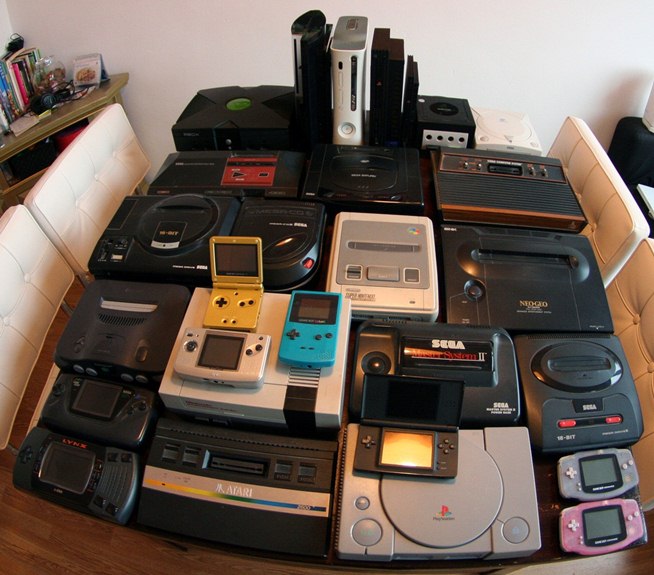
Most Xbox fans will rag on Playstation fans and vice versa, without any real reason to hate one another. (I would bring up the Nintendo Wii-U, but they're definitely not the focus in the "console war") We're all supposed to be lovers of Video Games, right?  Nope.  Comments sections of video game sites thrive on hating one another's personal preference.  Say one thing about a system you enjoy playing on and you'll find plenty of people quick to put it down.  If there are major differences between system specs and multi-platform games, you'll be sure to see them pointed out with meme's, quotes, statistical values (for those that go deeper than the name calling) and just flaming hatred in words.

Xbots and Ponys, just two of the derogatory slang terms given for fanboys of Xbox and Playstation, are often used when directly hating on gamers who love their respective systems.  But why? What is the point of directly bashing someone who enjoys the console they chose to purchase and support?  Sports fans have their reason: It's in the form of Championships.  At the end of a season, there is just one team that can prevail as the "best" for that year and get a shiny trophy, bragging rights, a trip to meet the president... and Disney World.

Video games?  Not so much.  Sure there are industry awards, but all gaming systems out there all share the same goal:  Entertainment of their customers. Those awards really don't sway a gamer from one system to the next, nor does it impact their purchases in any shape or form. (Youtube videos, Gaming sites offer a much bigger impact on players)  Why does it matter if the person playing an Xbox is enjoying themselves if you're a Playstation owner? Furthermore, why limit yourself to one console? If you love video games, owning one system is limiting you to the exclusive titles of that one system.  Understandably, cost is a major concern (especially the initial game console purchase), but no one is forcing anyone to buy all the shiny new systems at once.  I, myself, staggered out my system purchases and was able to "catch up" on all of the exclusive titles within a few months time through "combo" game packs and borrowing from friends.


The amount of hatred between system fanatics is flat out disgusting.  One of the most recent comment wars has been between PS+ and Xbox Live subscription differences and quite honestly, it's a pointless battle.  If you're not a video game player, both the Xbox and Playstation have subscription services that allow online video game play and other member perks including free, or discounted, games to download. (the cost is around 50 dollars a year)

The comment war that I referred to above is that Playstation Plus owners are "renting" free games while Xbox Live subscribers get to keep the games they download even if they choose to stop subscribing.

The real laugh about this flame war is that no respectable gamer is going to own a console without either of these services.  Both are incredibly amazing and *should* haves from the start.  Personally, I don't know a single person that doesn't have a subscription to their personal console of choice.  If you have Xbox, you more than likely have Xbox live and if you have Playstation, you more than likely have PS+.  It's absolutely a no brain decision to pick up the services. (Especially when they often come with a trial subscription for free just to see why you should pay for it).  The owner of the system will always have them, period.


So please fanboys, can't we all just get along?


Thursday, April 10, 2014

Subscription models in MMO's: Change is coming.

There has been a long, ongoing battle between what produces a MMORPG (Massive Multi-player Online Role Playing Game... Or MMO for short) as a better game: The monthly subscription (P2P) or the free to play (F2P) model.  Debates, and heated discussions, ignite like wildfire when a game developer publicly announces which model their MMO will be. Both sides of the fence have their reasons why their respective team is better and why the other one is a horrible choice for the game, but which is really the best option?

The MMO world is a fierce battleground when it comes to maintaining a substantial player base. It needs a specific amount of players to financially afford and maintain the servers and hardware that keep the game worlds alive and functioning.  Without people logging in to play, the MMO is doomed to fail and be forgotten about.

In the past, MMO game developers relied heavily on subscription based models to have a continual source of income to put into their game and staff.  Subscriptions averaged 15 dollars a month and expansions to the game were anywhere from 15 to 50 bucks.  Players were to expect regular content update and tweaks from the game developers in order to keep things fresh and exciting within the game world.  Developers often claimed that the funds from the subscription were vital resources to creating new content that players deserved.

But then mobile gaming and F2P came along.


F2P games take on the same philosophy that casinos have with their returning players: Give them something for free in hopes that they spend more in the long run.  Where a casino offers a free room or "free cash to play with", a game developer offers the entire game for free.  The catch with the game is the "extras" or the "perks" that a player can buy are extremely desirable and considered cheap.  Games like Farmville, and most recently Candy Crush, add in specific additions to the game that give the player an advantage.  A farm that produces yield instantly or an extra 5 lives for a dollar instead of waiting for a half hour can get the player hooked to spending.  But free is free.

MMO's started to adopt the philosophy of F2P early on but it has always been on shaky ground.  Guild Wars was one of the more respectable titles but others have seemed to fall on the wayside.  Many of the recent MMO's in the past decade have started out as subscription based games but have turned to the F2P model when they failed to maintain enough players under the P2P plan.  Some game developers have embraced the free model by not sticking it to the players wallets, where others have unfortunately nickle and dimed a franchise.

This is where the fierce battle begins because there are simply more bad F2P games than there are good ones.  But does it have to be that way? No.  In fact, the F2P model is seemingly gaining more ground as developers are realizing that a player will spend more if they're treated with respect.

Rift is the perfect example of how a developer can run its game with a F2P model and still be successful while producing quality content and keeping their players happy.  The team over at Trion gave its whole game for free:  Raids, instances, classes, characters, content, pvp...all of it.  It was a bold, last ditch move that was used to save the game from being shut down when the subscriber base disappeared. The development team took a look at what they can put on their pay market without giving players an edge in the end game stage.  What they found is that players just like fluff.  Pretty mounts and armor, something that gave their characters distinctive and unique looks, was high on the desired list.  Add in xp buffs to help level and they had themselves a competitive market place that didn't take away from the core of the game.

This philosophy of F2P game design is also something we will be seeing with Everquest Next.    David Georgeson, the development director over at EQN, supports a F2P model in saying that if the developers aren't keeping a player entertained that they don't deserve to be paid.  This is a bold and daring risk but the honesty is something to be commended.  The entire future of this game is being placed on the fact that it's all free for the player to enjoy and spend their money where they see fit. 

However, there are some developers that players feel the F2P model is being abused.  Most recently, Star Wars the Old Republic, ran by a development team from Bioware,  has fallen to the dark side. (Couldn't resist.)  One of the most anticipated and hyped games of the MMO world that started out as a subscription based pay model went F2P in under a year due to loss of subscribers.  Bioware instituted a F2P // P2P model that really pushed a player to subscribe with it's lack of "free" content.  Players were forced to purchase skill bars, bank space, character slots, races, the ability to do operations (raids) and warzones separately...   Bioware also seems to put more effort into the fluff of the "cartel market" which pushed players away from the game permanently.  Though the cartel market wasn't something that gave players advantages in the game, players felt that the emphasis of the development team was going in the wrong direction.  As the F2P model was put into place, more and more items were added into the Cartel Market while the core of the game was left essentially the same. Despite recent changes to SWTOR (with two expansions), and a generally more accepting player base, the F2P model has left a black mark on the franchise.

*I will note though that the F2P model had saved SWTOR.  Like it or not, the game went from a desolate graveyard of servers with miniscule populations, to full servers filled with players.*

In my opinion, many players are still scarred by past MMO's "free" to play models and are unable to accept games like Everquest Next's philosophy.  They feel that the developers of EQ will fall into the money trap and focus too much on the players wallets and not the content that they are supposed to be providing. However, there are more and more players who want that F2P option to try out the game to see if the MMO is worth investing in.  If the comments sections are any indication of the future, I feel that the MMO's that are being released this year (recently Elder Scrolls and Wildstar in June) will lose most of its subscribers within the first 6 months and be forced to re-think their philosophies on F2P.     


Wednesday, April 2, 2014

Diablo 3: Reaper of Souls Expansion Review


The recently released Reaper of Souls expansion has invigorated the Diablo series and redeemed Blizzard in most of the fans eyes.  So what has brought the series back onto its feet after being buried in negativity you may ask... Well let me tell you:

Let me just get this out of the way first:  The story of Act 5 really isn't much better than acts 1-4.  The CG-I opener of the game is the usual Blizzard greatness that we expect but it's already been all over the internet and you've probably seen it.  Though a few loose ends are tied up from the first acts, the story is just kind of there and isn't necessarily a compelling factor of playing the game.

Story aside (And arguably the price. 40 dollars is a little steep for a digital download of just a 1 act expansion with 1 more playable class)... Lets get to the major changes that make the expansion a redemption of the Diablo name.

Loot

The first major change actually came in a recent 2.0 patch to Diablo 3 as a precursor to the expansion.  A major complaint among the community was that the loot in the game really wasn't all that special and forced major issues with upgrading characters.  The previous loot design was that an item had 4 to 6 stat boosts and each of those were individually rolled with every stat in the game.  This caused a problem when you would get a rare, or legendary, because it could be completely worthless due to the mixed stats.  You could be playing your Wizard class and get a drop that had strength / dexterity and a Witch Doctor only special damage making the loot absolute garbage.  The randomness of the loot was such a deterring factor in the "end game" of Diablo that many players simply quit playing.  Finding upgrades to help push your character through Inferno was like finding the perfect needle in a pile of needles shoved somewhere in a mountain of a hay stack.  

With the patch, the stat rolls on a piece of gear changed to include what the class of the character you are playing and eliminated the "non essential stats" from classes you weren't playing. This is nicknamed the "smart loot" system.  Gear that dropped would only have stats that were beneficial to your character and made playing Diablo infinitely better again.  When a rare, or legendary, dropped there is a sense of excitement that what you pick up is an actual upgrade to the gear you have on.  Playing in the 2.0 patch after a hiatus made you feel like you were playing a completely different game and your characters that you had would all benefit from it.  

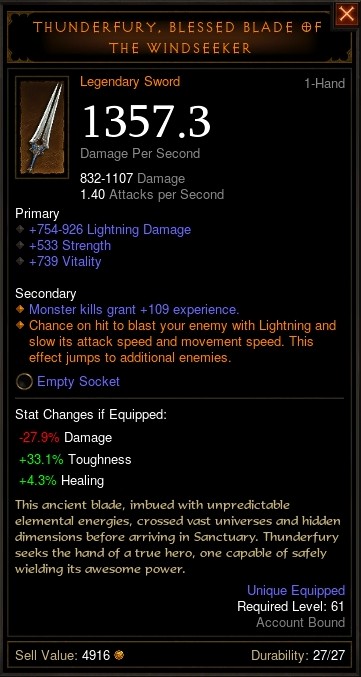
Finding legendary items also became a bit more exciting because of the newly designed philosophy about them.  These items were supposed to be immensely different from rares and not just be different because of the text written on the mouse-over of the item.  (Though I'm sure true lore fanatics loved the little text blurbs) Legendary items were no longer as insanely rare to find and when you did find them your character is more than likely able to use it because of the way stat rolls were changed.  These legendary items also had some bizarre and great special abilities.  For example:  There's an item that makes a treasure goblin follow you around collecting gray/white items.  When the goblin has collected a specific number of items, it spits out a rare (and can also drop a legendary) for you.  Blizzard also added a Thunderfury... with the same proc as it has in World of Warcraft. 

So with the change to loot, the major reason to be playing Diablo in the first place, Blizzard took a gigantic step in the right direction to fixing the core problems that plagued Diablo 3.  The next step was to fix the dreaded "end game" problem of being bored / discouraged to continue playing the mindless slaughter of monsters.  In order to do that, the developers decided to take a look at and tweak a system already in place.  

Torment, Paragon Levels and Crafting

In the 2.0 precursor patch to RoS, major system designs also received an overhaul.  Inferno, Paragon level cap and ridiculous material costs for crafting were all eliminated and replaced with systems that are infinitely better designed for the player.

Crafting: Crafting in Diablo 3 was a bit of a joke to players.  Sure some items could possibly be upgrades while leveling but you still had to deal with the random non intelligent roll factor of the stats and ridiculous material costs (not to mention the gold cost on top of that as you got higher item levels).  Basically the risk was not worth the reward and so crafting just fell to the wayside.  2.0 attempts to remedy that by eliminating a lot of the excess materials from your bags and have two sets of rare/blue/legendary material costs. One set from 1-60 and the other from 61-70.  The "smart loot" system is present now when using the smithy and items that you create are mostly always beneficial to your character class you make the item on.   While leveling new classes, the blacksmith retains the highest recipe list that you have and gives you the opportunity to constantly have that newbie class geared up.  This helps keep the gear disparity low if you've been having terrible luck out in the game with finding an upgrade.  

Torment Levels: The developers decided to completely eliminate Inferno mode and added a slew of new game modes to choose from.  Each of these game modes offer special bonuses and at level 60 you're allowed to use the "torment" difficulty option. Torment has a difficulty slide bar and with each notch you raise it, the xp/gold find and legendary item drop rate increases.  At 70, you're also given the bonus of regular mobs being able to drop "imperial gems" which are significantly better than previously crafted level 60 gems. 

Paragon Levels: Previously added to give more life and meaning to the "end game" of Diablo, paragon levels have had their level cap completely removed and also been giving 4 different categories with 4 subset character stat boosts.  Players are able to distribute points as they see fit for their character to boost up their main and secondary stats.
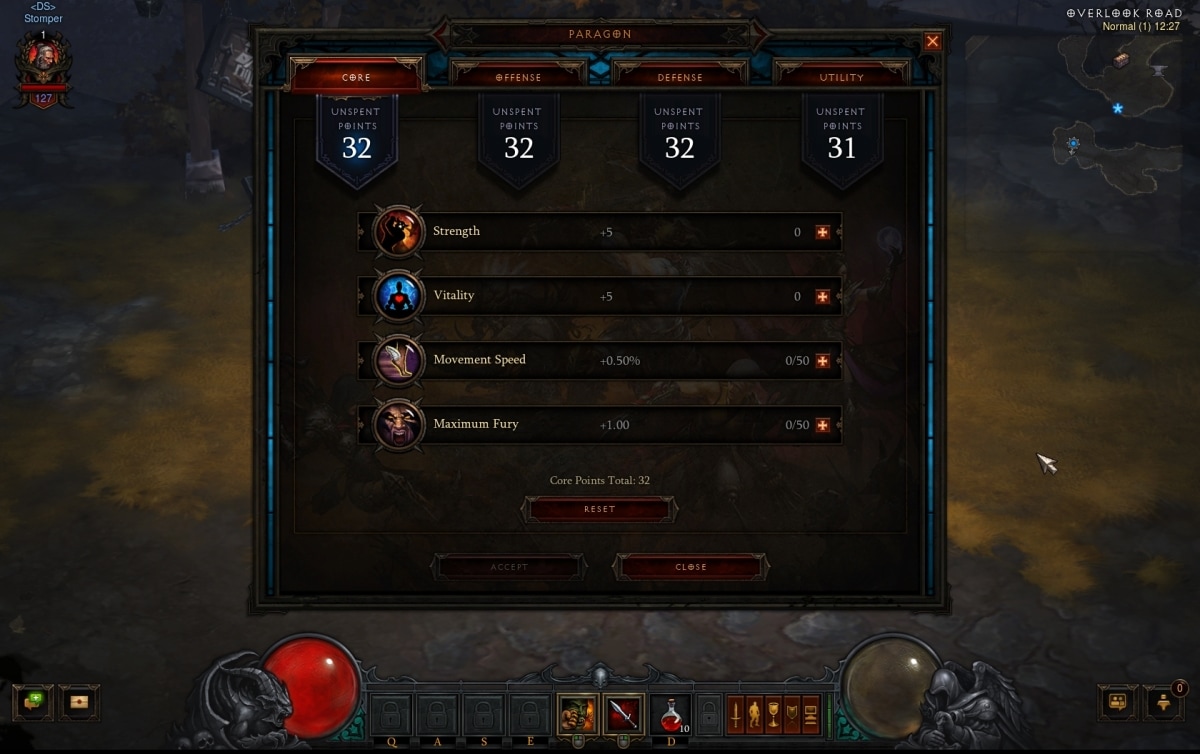
In this picture to the right, you can see that the player has 32 points in each category for the first three categories and 31 points in the last.  They are then able to choose the point distribution how they want, giving the player more control over the way their character is designed to be played.  If you feel your gear is lacking in vitality, for example, you can pump all of your points into that option.  The player is also able to change the points whenever they want with a very convenient reset button. (which just resets that category) So now when you're playing, your character is constantly gaining XP and becoming stronger with every point placement in the Paragon system's categories.  This breathes much needed life into the end game system and is further amplified by the addition of Adventure Mode.


Adventure Mode

The new game mode in Diablo is called Adventure mode and it is just that:  An adventure.   Once you play through act 5 and defeat Malthael, your account unlocks Adventure mode for all of your characters.  If you were sick and tired of redoing the acts per character, you no longer have to.  Instead you can take on bounties and Nephalem rifts to level up and this is truly the Diablo game mode that players have wanted. Adventure mode opens up all waypoints, bosses and acts for you to fully and freely explore the world. 

Bounties: In each act you are able to complete a series of 5 randomized bounties given to you by Tyrael which will yield you a chest that contains a bunch of rares (possibly a legendary), rift keystone fragments and other valuable items.  Each of the bounties are fast, ranging from killing a boss, to killing a named mob and 150 creatures in an area, to cleansing a cursed chest and so forth.  Moving to the next bounty once one is complete is incredibly easy:  Simply hit M and pick where you want to go.  After doing a bunch of bounties you may have acquired enough Rift Keystone Fragments to be able to open a Nephalem rift and the opportunity to slay a Rift Guardian within it.  

Nephalem Rifts: Once you've obtained 5 fragments, you are able to open up a rift to a randomly generated battlefield which pulls any type of monster from the game and inserts it into the tier.  Each tier of the Nephalem rift contains multiple named mobs, elite packs and an eventual Rift Guardian that spawns after you've killed a certain number of enemies.  While slaying pack after pack of mobs, a red bar on the right of your screen slowly fills up until the point you reach 100% filled, only then the Rift Guardian will spawn.  This guardian is essentially a boss fight and will drop a good cache of items once it's defeated.  


Adventure mode is a very simplistic way of making Diablo incredibly fun again and it works.  It gives you a reason to escape the general drag of repeating act 3 over and over and over again for loot and provides you all the elite packs and named mobs it can in quick, short periods of time.  The development team really knocked it out of the park with this and it will easily have players addicted to Diablo once again.

Oh. There's also a new hero class (the crusader) and Myriam the mystic! 

Myriam the mystic is a new NPC for your main town hub that you unlock during Act 5.  Once you unlock her, she is available for all of your characters on the account and this will definitely come in handy.  She's able to provide two services:  Enchanting and Transmogrify.   

Enchanting: With the "smart loot" system in place, enchanting can be an incredibly powerful thing for you.  Myriam is able to provide you with one, and only one, stat change on an item.  For example:  Say you have a set of gloves that have a +armor stat on them that you really just don't need.  You are able to select that stat and buy a new stat roll with some items and gold (both costs are dependent on the quality of the item).  If you don't like the two randomly generated things you were given, you can pay the same cost again in hopes of something better.  In the + armor category, you might just be able to upgrade that set of gloves to have a socket or attack speed in its place.  Items that are potentially a side-grade can become a major upgrade with a good re-roll of a stat!


Though I think this image was just pointing out a bug in the system, you can get the idea of what the enchanting screen looks like.  There on the left you can see the 6 stats that can potentially be "re-rolled".  When you hit the question mark next to the stat, the possible properties appear on the right.  Those possible properties are what can be re-rolled when you accept the cost and enchant the item.  Just remember though, you can only do one!


Transmogrify: The other thing you're able to do with Myriam is re-skin weapons and armor to a different appearance of a different item in the game.  This has been a popular feature in other games and players generally enjoy customizing the look of their characters as much as they can.  When you find certain items in the game, a "New Transmogrify" message will appear in the middle of your screen and you're then able to re-skin any item that you wish to that item. 

For example:  Did you find a Thunderfury and want every weapon you have in the future to look like it? Well you can once you unlock Myriam and give her over some gold.

The last new feature of the expansion is its new hero class:  
The Crusader.

That's also a new weapon for the Crusader only: The flail.
  Though I won't go into detail about the crusader (because honestly, you're going to want to play one), I will say that it is a very accepted addition to the cast of classes you're able to play.  

All that being said, Diablo 3: Reaper of Souls has finally brought the game back to where fans expected it to be.  A fun and action packed dungeon crawler with an addictive quality of excitement when you're craving it. I know 40 dollars and the past woes of this game might be a reason not to pick it up, but you'd be missing out.  This is the Diablo we wanted and now have to enjoy and I definitely recommend checking it out. 

((If I were to give this a number value on a scale from 1-10, I would give it a 9: Only losing a point because of the story.  Although act 5 is pretty mediocre, the dark and dreary moodiness of the level design brings Diablo back to its original roots.  The overall changes of the game have proven that the development team was listening and delivered what the fans of the game franchise wanted))   


Tuesday, April 1, 2014

Diablo 3 Expansion: Has Blizzard redeemed themselves?


Like many other Diablo fans, when the rumor mill started churning about a third game being created, excitement immediately coursed throughout my mind and body.  I also started to worry.  Times had changed in the PC gaming world since the last Diablo release in 2001.   Graphics cards and overall game play // game design had increased in quality at an exponential rate and social media caused a drastic change in the way developers had to look at their games.  If something was wrong, or just complete garbage, news of the atrocity would spread like wild fire through Twitter, Facebook or Reddit and fan reaction would be heard in full force.

Fast forward to 2012:

Despite it being one of the most anticipated and fastest selling games in a 24 hour period before release, Diablo 3 hit a major brick wall with fans on the first day... Error 37.  Players were unable to log in and since Blizzard removed the offline play mode of the game and required always online DRM(which fans were infuriated about), Diablo fans were forced to look at an unplayable game on their screen for a few days.

To add further insult to the fans, Blizzard created a vastly inferior story line to its predecessor and killed off a beloved main character which you had to see 4 times before hitting max level.  Players trudged through the level grind to hit 60 and start the real fun of endlessly grinding mobs for amazing loot for their characters... Or so they thought.  The end game of Diablo 3 was so horrid for quality itemized gear that the Auction House became your best friend. Later, Blizzard decided to add "real money" into it (the AH) causing even more of an outbreak of negative reactions.  Though some people were completely okay with this because they actually made some legitimate cash for playing a video game, it completely destroyed the game by being the straw that broke the camels back.

Diablo 3 was a dead game for awhile and Blizzard knew it because fans let them have it through twitter, forums and any other public venue that people could freely rage on.  They began to listen to the fans feedback and change the game for the better.   First, the developers attempted to figure out a way to make "end game" more viable by adding in the Paragon system and monster difficulty adjusters.  This gave a lot of players the opportunity to get passed the stone wall of Inferno and finish the game on its most difficult level without literally buying the gear off the AH to do so.  The paragon system gave hardcore players a reason to keep playing:  XP and Bonuses. Second, Blizzard knew they had to address the real money//regular AH and finally close it down for good.  They realized that players shouldn't be mindlessly farming gold and selling everything on the AH in order to obtain the gear that their character needed... That wasn't "Diablo".  Finally, the developers knew that they had to "right all the wrongs" with their expansion to D3.


Prior to the release of the expansion, Blizzard released a 2.0 Reaper of Souls patch.  This fundamentally changed the game and gave a preview of what was to come with the expansion.  In the patch, the way itemization was "rolled" on an item changed in a major positive way for the character you were playing.  Random stats that were not beneficial at all (IE strength on Wizard gear) would not be found on any item that dropped in the world.  This meant that when you were out there slaying demons and a rare or legendary dropped, you actually had a legitimate reason to be excited.  Whatever piece of gear that was laying on the ground could potentially be an upgrade where in the past it was more of a hope and prayer that it was.  

Honestly, the loot change single handily was the biggest and best change to make players want to come back and play.  (Though I will admit that torment levels and the increased drops of legendaries was nice as well)

So did Blizzard redeem themselves with this expansion? Check out my next blog to read my review of it!  (Spoilers: The answer was absolutely, Diablo is back and how it should be.)